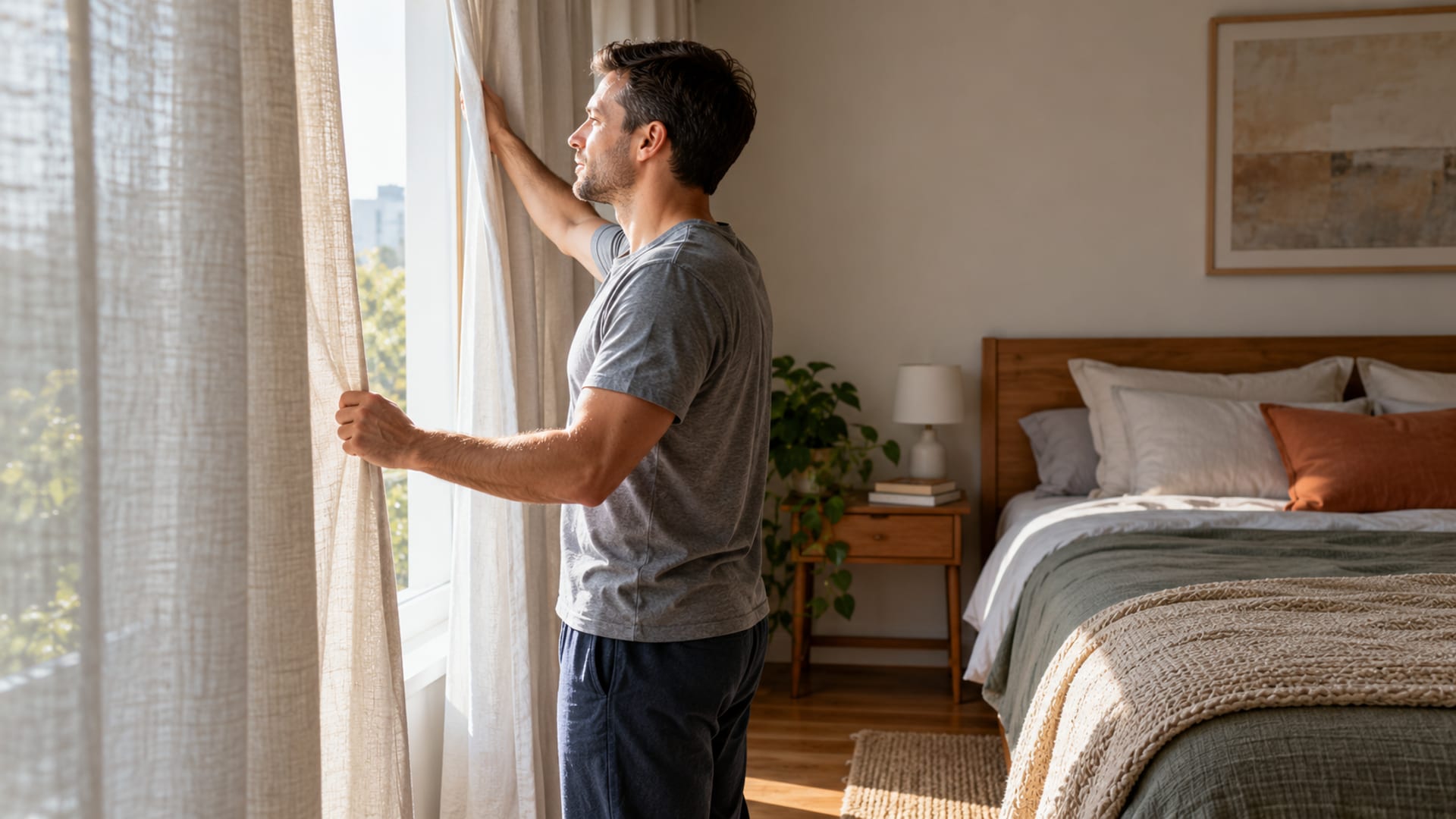
The alarm goes off, one hand finds the phone, and your head is already running the to-do list. A five-minute morning fits that moment. Open the curtains or step outside, wash your face, drink some water if you like, and say out loud the one thing that has to happen today.
There is no single best routine, so the ideas below are meant to be mixed and borrowed. You will find a five-minute morning, versions for a parent, a shift worker, a commuter and a home worker, a few steps for the night before, and a plain word on getting up early.
- Start tiny One or two actions are a routine; a five-minute morning counts.
- Prepare the night before Clothes, bag, first task and a bedtime that leaves room for sleep.
- Get daylight Step outside or sit by a bright window, even when it is cloudy.
- Early is not the point Enough sleep and a schedule that fits your life matter more than the clock.
- Keep a rough-day version A reduced routine beats an all-or-nothing one.
A five-minute morning
Start with the version that costs nothing and needs no special equipment. Turn off the alarm, open the curtains, and if you can, stand at an open door or step outside for a minute. Wash up, have a glass of water if that appeals, and put your clothes on, ideally the ones you set out the evening before. Then write one necessary task on a scrap of paper: "Send the form." "Call the pharmacy." "Finish page three."
On a rough day, shrink it again. Pick a single action, such as opening the curtains, and let that be the whole routine. It still counts, and it keeps the habit of starting the day on purpose without asking for energy you do not have.
If you have no outdoor access, the brightest spot you can reach works too, such as a chair next to a window. When you want more gentle ideas for looking after yourself beyond the morning, self-care ideas for everyday life has plenty that take only a few minutes.
Mornings with young children
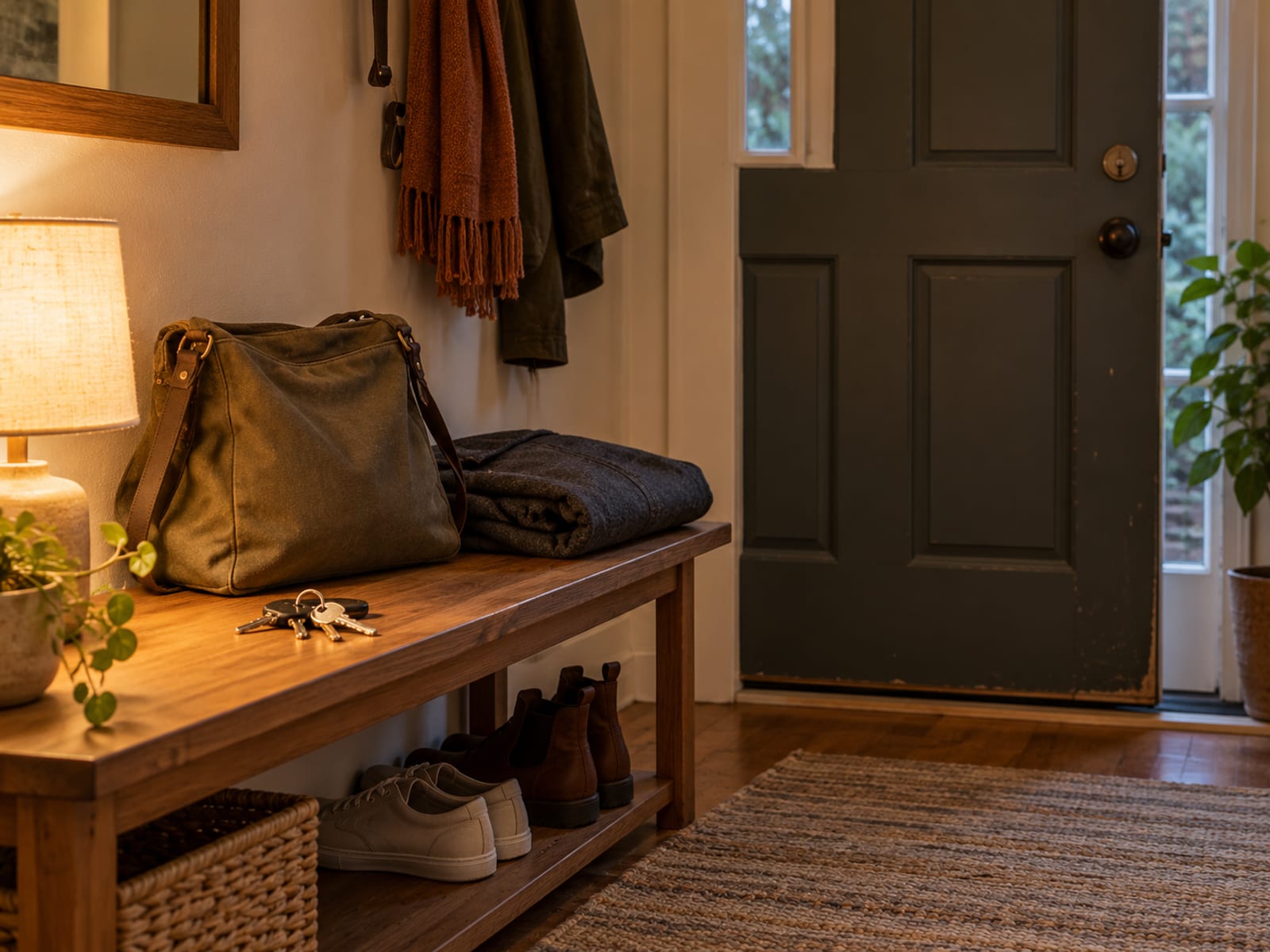
When small people are involved, the morning often starts the night before. After dinner, put clothes and bags by the door, and let the last tired task of the evening be the one that saves you a scramble. Some parents like to be up two minutes before the children, just long enough to wash and look out of a window. Others attach a short walk to school drop-off, so movement happens without needing its own slot.

A bad night changes the plan, and that is fine. The reduced version might be water, shoes on, and out of the door. Nobody is keeping score.
In a shared household, it helps to agree on a quiet order of events so people are not competing for the bathroom or the kettle. Headphones are fine when it is safe to wear them, and a shorter version makes sense on mornings when someone needs care. Carers, and anyone whose body needs a slower start, can treat the same ideas as options to stretch out, not a standard to hit.
Shift work, a long commute or working from home
If you work shifts, "morning" is simply the stretch after your main sleep, whatever the clock says. Protect that sleep first, then eat something, wash, and move for a few minutes before you travel. A quick safety check at the door is worth building in: keys, lights, how awake you really feel. Health agencies offer practical advice for coping with night and evening shifts that you can adapt to your own roster.
If you commute, make your routine portable. Pack food and clothes the night before, take whatever daylight the walk between connections gives you, and keep one minute before work without headphones or news. "Phone stays in my pocket until I sit down" is a sentence a person could actually say, and it is easy to drop on days when you need the map.
If you work from home, the trap is rolling from bed to laptop in one motion. Leave the bedroom, wash and dress, and spend a few minutes near a window or outside. Then start with a single task you wrote down the evening before, so the first decision of the day has already been made.
| Part | Flexible option | Worth knowing |
|---|---|---|
| PartLight | Flexible optionOutdoor light, or the brightest spot by a window | Worth knowingDaylight helps your body clock, even on a cloudy day |
| PartWake time | Flexible optionRoughly the same time when you can | Worth knowingEnough sleep matters more than how early |
| PartMovement | Flexible optionA short walk, stretching or exercise whenever it suits you | Worth knowingNo single best time of day |
| PartBreakfast | Flexible optionEat if you are hungry or it helps your day | Worth knowingNot required for everyone |
| PartPhone | Flexible optionEssential use only, a delayed check or a short phone-free stretch | Worth knowingEvening screens are more linked to poor sleep than morning ones |
Does waking up early matter?
There is no sign that waking at 5 am makes people more successful. What does seem to matter is whether you get enough sleep, since most adults need at least seven hours, whether your hours fit your work and family, and where your own body clock sits. Some people lean toward mornings, some toward evenings, and many land in between.

If you want to move your wake time earlier, move your bedtime earlier as well. An earlier alarm on the same bedtime only takes sleep away. Health agencies suggest getting daylight and keeping sleep and wake times fairly regular, which leaves a lot of room for your own schedule. If guilt about resting is part of the picture, how to rest without guilt is a gentler read.
Celebrity routines, the 5 am rule, the 4 am rule, the Miracle Morning and the 20/20/20 idea (twenty minutes each of movement, reflection and learning) can all be ideas to borrow. Take the piece that suits you, such as a walk or a quiet half hour, and leave the rest. And if you wondered whether getting up at 7 is fine, for many people it is, as long as the sleep behind it is enough.
What to do the night before
A calm morning is usually built in the last half hour of the evening. The small steps below take about ten minutes, and you can do only the ones that suit you.
- Put out clothes, work materials and anything you carry daily, including medication.
- Write down the first task and leave it where you will see it.
- Prepare a simple breakfast or pack food, if eating early helps you.
- Set a bedtime that leaves room for enough sleep, not just an earlier alarm.
- Let the household know when your sleep is protected, if you work odd hours.
If screens keep you up, putting them away a little earlier can make falling asleep easier. Keep the whole plan small enough to survive a poor-sleep day. "Clothes out, bag by the door, lunch in the fridge" is already a good night's work.
One calm note: if you are often very sleepy in the daytime, snore loudly, have trouble sleeping most nights, or find that low mood or worry makes mornings very hard, a doctor or another health professional can help. Do not drive or do safety-critical work when dangerously sleepy.
1. What counts as "morning" for someone who works nights?
2. You want to wake up earlier. What else should move?
3. What is a good first addition to a new routine?
4. You have no time at all today. What works?
Light, movement, breakfast and your phone
People often ask what the healthiest thing to do first thing is, and the short answer is that no single ritual wins. Daylight is a good place to start, because even a cloudy day is brighter than most rooms. A few minutes at a window or on the doorstep supports the body's sleep and wake rhythm.
Movement helps at any time that suits you, so a short walk is an easy morning choice. For a few gentle moves at home, try a couple of minutes of stretching, a slow walk around the block, or some easy mobility work for the shoulders and hips. Stop whenever something hurts, and treat it as an option, not a workout you owe anyone.
Breakfast is for when you are hungry or when it helps your day. A review of trials on breakfast found no reliable weight-loss advantage from eating it, so skipping it is not a sin, and eating it is not a rule. Health conditions, culture and access to food all play a part, so choose what fits.
Checking your phone first thing is not automatically harmful. The useful question is whether it delays you, stresses you, or crowds out sleep, light, food and getting ready. Evening screens have the clearer link to later bedtimes. If you want to try something, a short notification-free interval after waking is easy to test, and you can drop it if it adds nothing.
Building it slowly so it sticks
Pick one action, tie it to something you already do, and make it easy enough for your shortest morning. "I will open the curtains right after I turn off the alarm" is a complete plan. Doing the same thing in the same setting is how an action starts to feel automatic, which is why a cue like the alarm helps.
Pick one action
Open the curtains or put on your shoes.
Tie it to a cue
Do it right after you turn off the alarm.
Make it easy
Shrink it until it works on your shortest morning.
Repeat it the same way
Same order, same place, when you can.
Add one more
Only when the first feels manageable, such as a five-minute walk.
A first week might be as simple as alarm, curtains, bag by the door. Later, you could add a five-minute walk. On messy days, use the reduced version instead of calling one missed morning a failure. If you want a wider view of how small actions turn into habits, how to build a habit goes into it.
Questions people ask
These are the questions that come up most often when people start putting a morning together.
What is the best morning routine?
There is no single best one. The best routine is the one that protects enough sleep and fits your day, whether that is five minutes or an hour. The five-minute morning above is a good place to begin, and you can add to it as you like.
What is a very simple morning routine?
Open the curtains or step outside, wash, drink water if you want it, and name one task for the day. That is a full routine. Leaving your clothes out the night before makes it even smoother.
Does waking up at 5 am make you more successful?
No evidence shows that it does. Sleep and fit matter far more than the clock, and the celebrity routines you read about are stories, not proof. If 5 am suits your body and your bedtime, fine; if not, a later start is just as good.
What is the healthiest thing to do first thing in the morning?
There is no magic ritual. Daylight, a short walk and food if you are hungry are all easy choices, and none is required. Pick the one that fits your morning today.
What should I do when I wake up if I have no time?
Choose one action and tie it to something you already do, such as opening the curtains after the alarm. Then add a few night-before steps, like clothes out and bag packed, so the morning has less to decide. Small and repeated beats big and abandoned.
Is it good to get up at 7?
For many people, yes, as long as they sleep enough before it. Shift workers can treat "morning" as the time after their main sleep, whatever the clock says. If 7 leaves you rested and on time, it is a good wake time.
One thing to try this week
Pick one action for tomorrow morning: open the curtains, step outside for two minutes, or put the bag by the door tonight. Tie it to something you already do, and on the weekend, notice whether to keep it, shrink it or swap it. On a hard day, the rough-day version is just the curtains. Motivation Facts has more guides in the Self-Care and Wellbeing section, and if you would like to plan what to work on next, the personal development plan offers a goal planner. You can also reach us through the contact page.
Morning routine. A few actions you repeat after waking, from one step to a longer block.
Body clock. The natural daily rhythm that helps set when you feel awake or sleepy.
Daylight exposure. Time spent in natural light, outdoors or near a bright window.
Night-before prep. Small tasks done in the evening, such as setting out clothes or packing a bag.
Cue. Something you already do that reminds you to start a new action.
Reduced version. A smaller form of your routine for rough or rushed days.
Chronotype. Your natural lean toward mornings, evenings or somewhere in between.