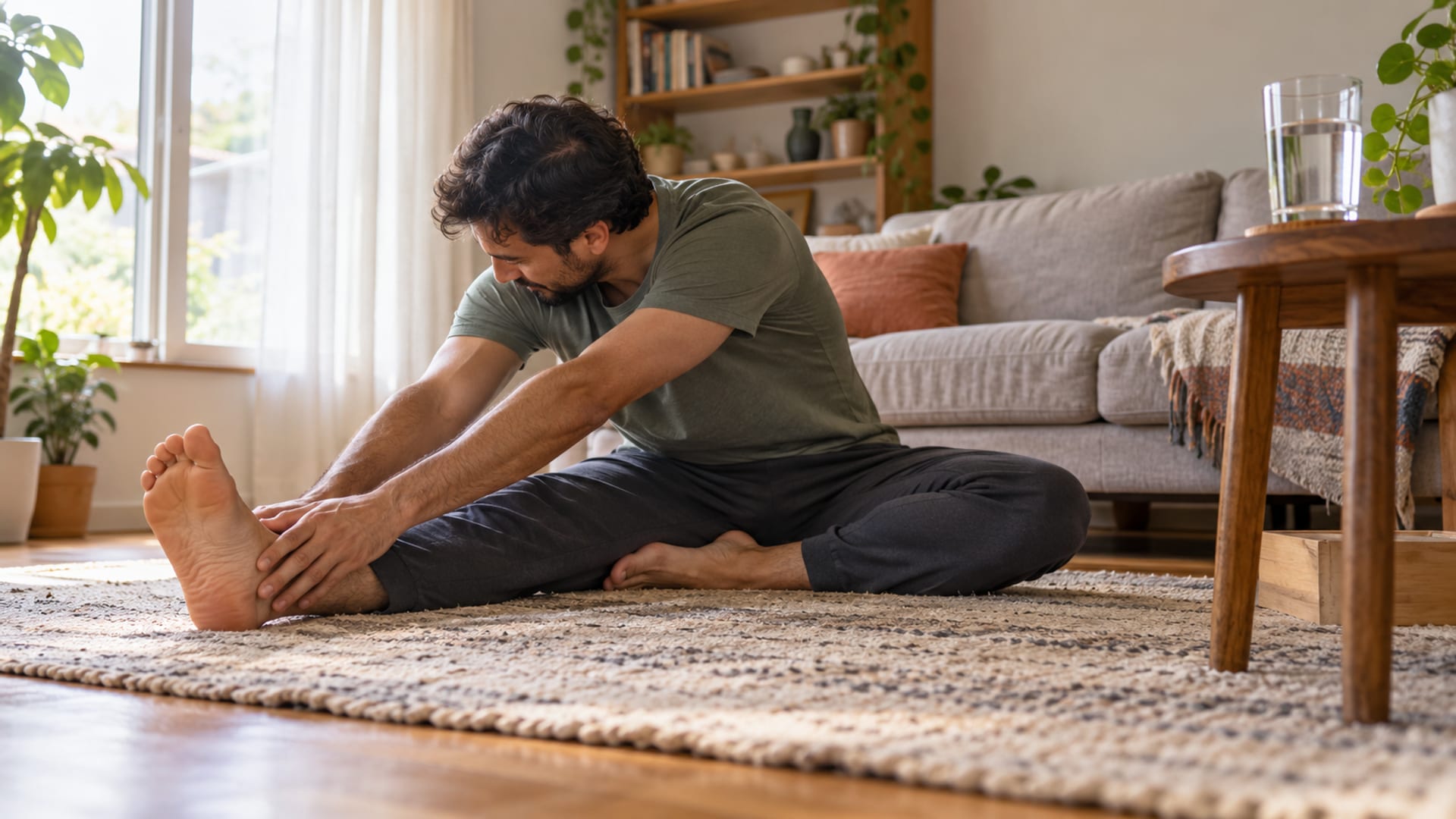

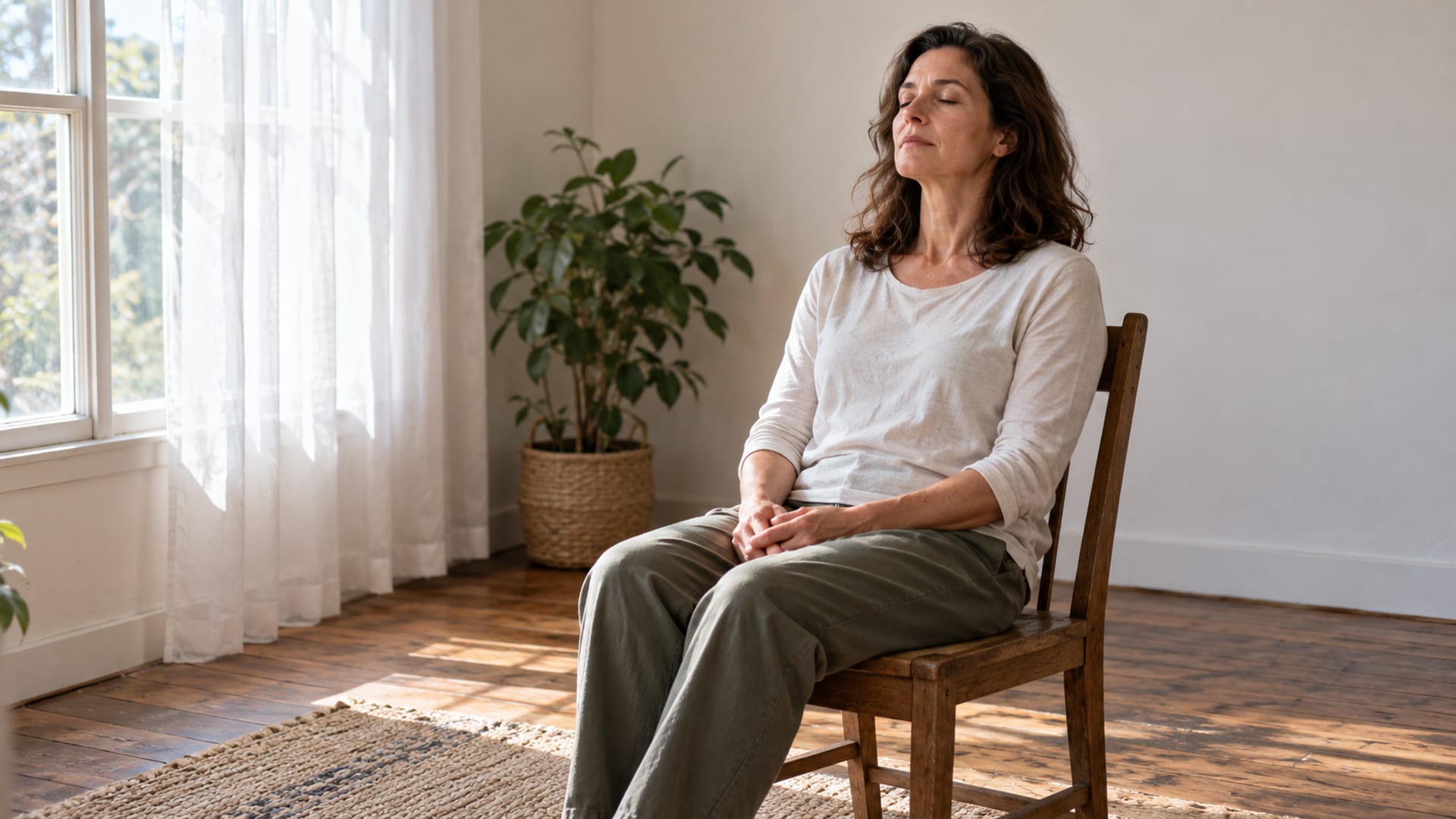
You are standing by the kettle, and somewhere in those ninety seconds you have picked up your phone or started rehearsing a conversation that has not happened yet. Try this before the water boils. Feel your feet on the floor and follow one or two natural breaths.
When your mind wanders off, which it will, quietly say "thinking" and come back to the next breath. That return is the whole exercise, and nothing about it needs a quiet room.
Below you will find what mindfulness is in plain words, a one-minute breathing exercise, the 5-4-3-2-1 senses exercise, a five-minute practice for home, ways to fit it into a busy day, what to do when your mind wanders, and when to go gently.
- Start tiny One minute of breathing counts.
- Use what is around you Walking, washing dishes and waiting in line are all chances to practise.
- Expect your mind to wander Noticing and coming back is the exercise.
- Try 5-4-3-2-1 Name things you see, feel, hear, smell and taste to land in the room.
- Go gently Stop or change the exercise if it feels worse, and talk to a doctor or therapist if distress stays.
What mindfulness is, in plain words
Mindfulness means noticing what is happening right now, whether that is a thought, a feeling, a tight shoulder, a sound from the street or the warmth of a mug. The only twist is that you notice it with some curiosity instead of rushing to judge it. A public health guide from the NHS describes it in much the same way, as paying attention to the present moment, including your thoughts, feelings, body and surroundings.
It does not mean emptying your head or switching thoughts off. Thoughts keep arriving; you simply notice them without following every one.
Meditation is one way to practise mindfulness, usually sitting down for a set time. But mindfulness can also happen while you walk, eat, wash dishes or wait in line, so you do not need to carve out a special hour. Yoga is a separate practice that can include close attention to the body, while mindfulness needs no postures, mat or class. It can also be practised without any religious belief.
A first exercise: one minute of breathing
Breathing is the easiest place to start because you are already doing it. Sit, stand or walk somewhere safe, and set a timer for one minute if that helps you stop checking the clock.

- Notice one or two natural breaths.
- Feel where the breath is clearest, perhaps at the nose, the chest or the belly.
- When your attention drifts, silently say "thinking" or "planning".
- Come back to the next breath.
- Keep going until the minute is up.
Do not try to breathe deeply or in any special way. Let the breath stay comfortable and ordinary, and if it feels odd to watch it, that is fine too. Your attention will leave the breath many times in sixty seconds. Coming back each time is the practice, not a sign it is going badly.
The 5-4-3-2-1 exercise
Sometimes the breath is a hard place to rest your attention, especially on a tense day. The 5-4-3-2-1 exercise gives your mind a series of small jobs in the room around you. Name five things you can see, four things you can feel, three things you can hear and two things you can smell. Then finish with one thing you can taste, or one slow breath if there is nothing to taste.
The feel step can be as ordinary as the fabric of your sleeve, the chair under you or your feet in your shoes. Say each one to yourself in a few words: "grey door", "cold hands", "a fridge humming".
It is a noticing exercise that anchors you in the room you are in, not a treatment for anything. Because it works with your eyes open, it is handy almost anywhere, on a bus, in a hallway or at the back of a meeting.
A five-minute practice at home
When you have five minutes and a timer, you can string a few short exercises together. Settle with some breathing, move your attention slowly through your body, use your senses for a minute, then check in. The timeline below shows how the minutes can run.
Minute 1, settle
Sit comfortably, feel the chair and floor, and follow a few natural breaths.
Minutes 2 and 3, body scan
Move your attention slowly from your feet to your legs, belly, chest, shoulders, hands, neck and face.
Minute 4, five senses
Use 5-4-3-2-1, or simply listen to the sounds around you.
Minute 5, check in
Notice how you feel right now, then choose what you want to do next.
During the body scan, notice pressure, warmth, tingling or nothing much at all, and do not try to change any of it. If a sensation feels too intense, go back to your breath or open your eyes and look around the room.

That is the five-minute version. If you have a free afternoon, you can add a slow walk, feeling each foot lift, move and land, or a cup of tea you drink without your phone. If money is tight, nothing here costs anything: written steps and free public-health guides are enough, with no course or app to buy.
Eating works as another way in. Take one bite of something and notice how it looks, smells, feels and tastes before you take the next. Skip that one if food is a difficult subject for you.
| Practice | How to start | Starting time | If your mind wanders | Go gently |
|---|---|---|---|---|
| PracticeBreathing | How to startNotice natural breaths and return gently | Starting time1 minute | If your mind wandersSay "thinking", then return | Go gentlyDo not force or control your breathing |
| PracticeBody scan | How to startMove attention through body areas | Starting time2 to 5 minutes | If your mind wandersReturn to the current area or the breath | Go gentlyShift away from sensations that become too intense |
| PracticeWalking | How to startNotice standing, lifting, moving and placing your feet | Starting time2 to 5 minutes | If your mind wandersReturn to the next step | Go gentlyOnly where walking is safe |
| PracticeEating | How to startNotice how food looks, smells, tastes and feels | Starting time1 to 3 bites | If your mind wandersReturn to the food | Go gentlySkip it if food is a difficult subject for you |
| PracticeFive senses | How to startNotice sights, touch, sounds, smells and taste | Starting time1 to 2 minutes | If your mind wandersReturn to the next sense | Go gentlyKeep your eyes open if that feels safer |
Fitting it into a busy day
The easiest way to practise is to hang it on something that already happens, so you are not adding a block to a full schedule. You can borrow any of these and drop the rest.
- In a queue, feel both feet on the floor, hear the sounds nearby and follow your next breath, keeping your awareness wide enough to stay alert to people around you.
- While washing dishes, notice the water temperature, the weight of each dish and the smell of the soap, and when your mind starts rehearsing the day, come back to the next sensation in your hands.
- Before a meeting, take three comfortable breaths, notice your chair, your feet and your shoulders, and choose one intention, such as listening to the first question before you prepare a reply.
- At work, let a transition such as opening a document or walking to another room be your cue for one breath.
- Before you open email, take one minute of breathing first.
On a commute, notice the seat under you and the sounds around you if someone else is driving. If you are the one driving, keep your attention on the road and let awareness of your posture and breath stay brief.
At home with children or housemates, you will not get silence, and you do not need it. Thirty to sixty seconds during a routine task, eyes open and ears still tuned to what the household needs, is a perfectly good practice. If you work shifts, attach a one-minute practice to the start of a break instead of a time on the clock.
When your phone is the thing that keeps pulling you out of it, ways to use your phone less can help you make the pauses easier to keep.
1. Your mind wanders off the breath for the fifth time. What fits?
2. You are in a short wait with no privacy. What fits?
3. How long can a beginner start with?
4. An exercise makes you feel worse. What fits?
When your mind wanders, and the attitudes that help
A mind that wanders is working as expected. Noticing that you have drifted and coming back is the exercise itself, so each drift is another chance to practise rather than a lapse. If it helps, give the thought a neutral label such as "planning", "remembering" or "worrying" and then return to your anchor, whether that is the breath, your feet or the sounds in the room.

A few attitudes make this easier, and they are all ordinary.
Non-judging means you notice a thought without scoring it, or yourself. "Oh, I'm making a shopping list" is enough. Patience means it takes the time it takes, and some days your attention will feel slippery from start to finish.
Beginner's mind means treating a familiar breath or a cup of tea as if you were meeting it for the first time. Gentleness means you return without criticism, the way you would nudge a friend back to a conversation, not scold them for losing the thread.
How long, how often, and when to go gently
There is no single dose for beginners. A practical starting point is one to five minutes, a few days a week, or a short practice attached to something you already do, like the kettle or the first minute at your desk. Add time only if it stays manageable, and it is fine to stay at one minute for as long as you like.
You do not need a course, equipment or an app, since longer courses use a lot more practice than a beginner needs. A US government health site says the evidence for mindfulness is promising for some outcomes but limited, which is a reason to treat it as a skill to try rather than a cure.
Some people find mindfulness unsettling, and it is not a treatment for trauma, severe anxiety or depression. If your distress rises, stop or shorten the practice, open your eyes and look around the room, or do something active instead. If it persists, becomes intense or gets in the way of daily life, or if trauma is part of your story, talk to a doctor or therapist.
If you want more ideas for a heavy week, how to manage stress covers other everyday options. And a short body scan can fit into sleep hygiene tips for the evening; stop if it becomes uncomfortable.
Questions people ask
These are the questions that come up most often when someone is getting started.
How do I start mindfulness as a beginner?
Start with one minute of breathing at a cue you already have, such as the kettle or the first minute at your desk. Pairing it with something that happens daily means you do not have to remember a separate appointment with yourself.
Is mindfulness the same as meditation?
Not quite. Meditation is one way to practise mindfulness, while mindfulness can also happen as you walk, eat or wait in line. Yoga is a different practice that can include mindful attention to the body.
How long should a beginner practise?
One to five minutes, a few days a week, is a sensible place to begin. No fixed amount is right for everyone, so let it grow only if it feels manageable.
What do I do when my mind will not stay quiet?
A busy mind is normal, so label the thought ("planning", "worrying") and return to the next breath. When breath-focus feels hard, 5-4-3-2-1 is a good anchor because it gives your attention things to do in the room.
What is the 5-4-3-2-1 technique?
It is a noticing exercise: five things you can see, four you can feel, three you can hear, two you can smell and one you can taste, or one slow breath. It works with your eyes open, and the full steps are in the section on the 5-4-3-2-1 exercise above.
Who should be careful with mindfulness?
Anyone who finds it unsettling should stop or change the exercise, because it is not a treatment for trauma, severe anxiety or depression. A doctor or therapist is the right person to talk to if distress persists, and no religious belief is needed to practise.
One thing to try this week
Pick one cue you already have, such as the kettle, the first minute at your desk or the dishes. Do one minute of breathing there on three days, say "thinking" when your mind wanders and come back, then notice whether you want to do it again. Next week you can add the 5-4-3-2-1 or the five-minute practice, or leave it for now, and either choice is fine. For more ideas like this one, Motivation Facts keeps its Self-care and Wellbeing guides in one section, and you can always contact us with a topic you would like covered.
Mindfulness. Noticing what is happening right now, in your thoughts, body and surroundings, with curiosity instead of quick judgment.
Meditation. A set-aside time to practise attention, one of several ways to build mindfulness.
Anchor. Something steady to return to when your mind wanders, such as your breath, your feet or the sounds around you.
Body scan. Moving your attention slowly through the body, noticing sensations without trying to change them.
Grounding. Bringing attention back to the room and the senses, as the 5-4-3-2-1 exercise does.
Labelling a thought. Giving a wandering thought a short neutral name, such as "planning", before returning to your anchor.
Beginner's mind. Treating something familiar, like a breath or a cup of tea, as if for the first time.